If you’re adding crypto payments to a store, this is the first decision that actually matters, and most guides skip it entirely. They jump straight into “install this plugin, connect this wallet” without explaining that the plugin you pick determines who controls your customers’ money for a window of time you might not even notice.
Table of Contents
That word, custody, sounds like legal jargon. In practice it answers one question: when a customer pays, whose wallet does the money sit in before it reaches you? Get this wrong and you’ve built your checkout on top of counterparty risk you never agreed to take.
What “custodial” actually means
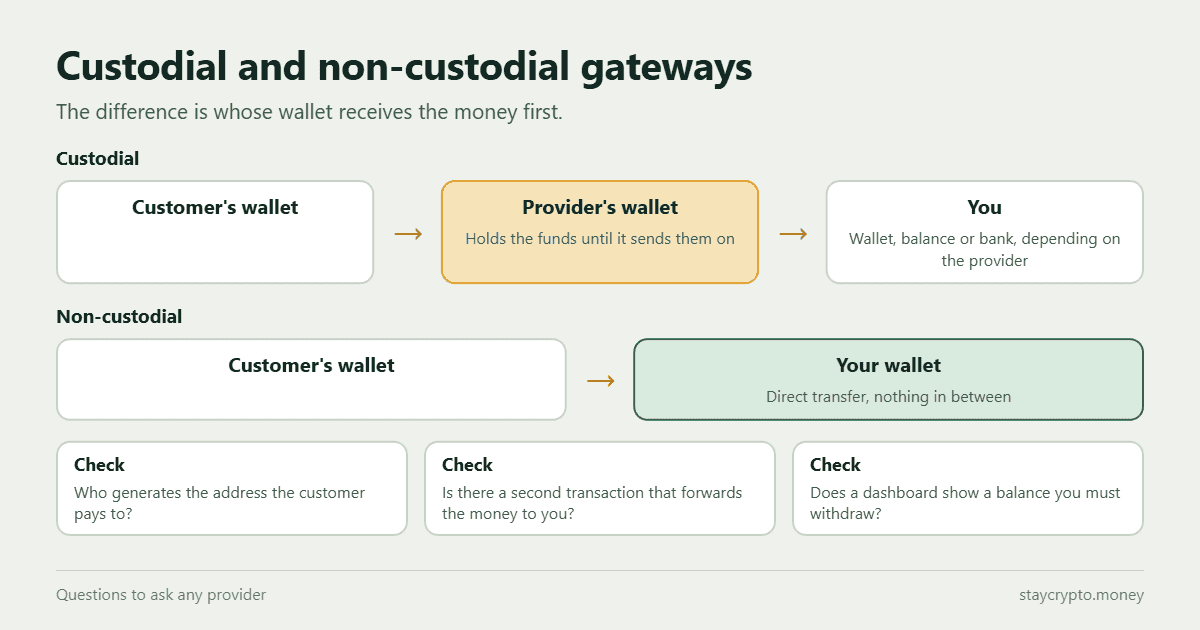
A custodial payment gateway receives the customer’s payment into its own wallet first. The provider holds the funds, often converts them according to its own logic (sometimes into a stablecoin, sometimes into fiat), and then sends you the balance, usually on a schedule: instantly, daily, or on request.
This is the model most people are used to from traditional payment processors, and for good reason. It removes a lot of friction. You don’t manage private keys. You get a dashboard with transaction history. If something breaks, there’s a support team to email. Onboarding takes minutes.
The trade-off is that during the time your funds sit in the provider’s wallet, they are not really yours. They’re an entry on someone else’s ledger that they’ve promised to honor. Most of the time, that promise holds. But “most of the time” is doing a lot of work in that sentence, and the crypto industry has produced enough counterexamples in the last several years that the risk is no longer theoretical: exchanges have frozen withdrawals during liquidity crunches, and at least one, FTX, went insolvent with billions of dollars in customer funds still on its books.
None of this means custodial gateways are bad. For a lot of merchants, the convenience is worth the risk, especially at low transaction volumes where the exposure on any given day is small. But when you’re weighing a custodial vs non-custodial crypto payment gateway, this is a trade-off you should make on purpose, not one you discover after the fact.
What is a non-custodial crypto payment gateway?
A non-custodial crypto payment gateway never holds your customers’ money. The payment goes straight from the customer’s wallet to a wallet you control, which is why it is also called a self-custodial payment gateway. The provider’s software watches the blockchain, matches incoming payments to orders, and triggers your webhook, but it never takes possession of the funds. There’s no intermediate wallet for the provider to freeze, no balance sitting on their books, no withdrawal request to submit.
This shifts responsibility onto you. You hold the private keys, which means you’re responsible for keeping them safe. You handle your own order reconciliation logic, either through the plugin’s built-in system or your own. If you lose your keys, nobody can recover them for you, there’s no support ticket that fixes that.
In exchange, you get something custodial gateways structurally cannot offer: nobody but you can block access to that money. No compliance hold, no frozen withdrawal, no insolvency risk on the provider’s side, because the provider was never holding your funds in the first place.
The Pseudo-Custodial Trap
Here’s the part that doesn’t get covered enough, and it matters if you’re actually comparing providers rather than taking marketing copy at face value.
A gateway can describe itself as non-custodial and still take a custodial step in the middle. In that design the customer pays into an address the provider controls, the provider’s system detects the payment, and then it sends a second transaction to forward the funds to your wallet. Between the two transactions, sometimes seconds, sometimes longer if their infrastructure is under load, the provider holds your money. That’s custody, whatever the marketing page calls it.
It is worth checking, because the difference only shows when something goes wrong: during an outage, a compliance review, or a spike in network congestion, funds sitting in an intermediate address are exposed to it. We name no provider here. Use the test below on any gateway you are considering.
There’s a simple test. Ask the provider, or check the documentation: who generates the payment address the customer sends to? If the provider generates it and then forwards funds from it, you’re looking at an intermediate wallet, even if the total time funds spend there is short. If your wallet (or a key derived from it, like an xPub) generates the address directly, the payment goes straight to you with no forwarding step required.
Custodial vs non-custodial: side by side
| Custodial | Non-Custodial | |
|---|---|---|
| Who holds funds first | Provider | You |
| Private key management | Provider’s responsibility | Your responsibility |
| Withdrawal freeze risk | Possible | Not applicable |
| KYC requirements | Depends on the provider and the features you use | Depends on the provider (StayCrypto has none built in) |
| Chargebacks | Not applicable (crypto is final either way; see why crypto chargebacks do not exist) | Not applicable |
| Regulatory exposure | Shared with provider | Falls on you |
| Fiat settlement | Built in by some providers | Rare, needs a separate step |
| Support for lost funds | Provider can sometimes intervene | Nobody can recover lost keys |
The real risks of custodial gateways
The headline risk is obvious: the provider could freeze or lose access to funds that are, at that moment, sitting in their infrastructure rather than yours. But there are smaller, more common versions of this that matter more day to day.
Compliance holds are one example of how a provider’s decision can reach you. A payment pattern that looks unusual, even for entirely legitimate reasons, can trigger a manual review that delays your payout. If you’re relying on that cash flow to pay suppliers or payroll, a multi-day hold is a real operational problem, not just an inconvenience.
Fee structures can also have more lines than the headline suggests: an exchange charge, a payout fee, a conversion spread. Our post on what a headline fee leaves out shows what two gateways publish on their own pricing pages.
The real trade-offs of non-custodial gateways
Non-custodial isn’t a free upgrade. You’re taking on real responsibility in exchange for removing counterparty risk.
Key management is the big one. If your wallet’s seed phrase is lost or compromised, there’s no institution to call. This is manageable with basic hygiene (hardware wallets, proper backups) but it’s a genuinely different mental model from “the payment processor handles security.”
Order reconciliation is the second practical challenge. When payments go directly to your wallet instead of through a provider’s centralized system, something needs to match an incoming blockchain transaction to the right order. This is usually solved either by generating a unique receiving address per order or by having customers pay a slightly adjusted amount that gets matched against the exact figure. Either approach works, but it’s infrastructure you’re now depending on, rather than infrastructure hidden behind someone else’s API.
Compliance also becomes entirely your problem in a non-custodial setup, since there’s no provider handling AML/KYC on your behalf. For most small and mid-sized merchants selling ordinary goods, this is a manageable responsibility. For businesses in higher-risk categories, it’s worth talking to someone who understands the regulatory picture in your specific jurisdiction before committing to a model.
How to verify a gateway is truly non-custodial
Before you commit to any provider, use this checklist to confirm which side of the custodial vs non-custodial crypto payment gateway divide it actually falls on, regardless of what the marketing copy claims:
- Who generates the payment address? If it’s derived from your own wallet (an xPub key or similar), that’s a strong signal. If the provider generates it independently, ask what happens next.
- Is there a forwarding transaction? Look at the technical documentation, or ask directly, whether payments are forwarded from a provider-controlled address to yours. If yes, there’s a custody window, however brief.
- Do they ever hold a balance on your behalf? A dashboard showing an “available balance” that you need to withdraw is a custodial signal. A dashboard that just shows a log of payments already sent to your wallet is not.
- What happens during an outage? If their servers go down, does your money stop moving because it’s stuck in their infrastructure, or does it keep flowing because it never left the blockchain to begin with?
Which model fits which business
There’s no single right answer to the custodial vs non-custodial crypto payment gateway question, and the right choice depends on what you’re actually optimizing for.
Small stores and side projects often do fine with a custodial gateway. Transaction volume is low, so the exposure at any given time is small, and the convenience of not managing private keys is worth more than the marginal risk.
Stores in categories that some providers restrict may prefer a non-custodial setup, because no provider decides whether they can keep accepting payments. Check each provider’s terms for your category, since they differ.
Larger merchants with consistent cash flow needs should weigh the operational cost of a compliance hold against the operational cost of managing keys internally. There’s no universal winner here, it depends on your team’s technical comfort and how much a multi-day payout delay would actually hurt.
Merchants who care about sovereignty as a principle, not just a risk calculation, will generally prefer non-custodial regardless of the numbers, because the point isn’t purely financial. It’s about not depending on a third party’s continued goodwill to access money that’s already been paid to them.
How StayCrypto approaches this
StayCrypto is built non-custodial from the ground up. Payments across BNB Chain, Polygon, Tron, and Ethereum go directly to wallet addresses you control, with order matching handled through a unique-amount system rather than a forwarding transaction. If you’re comparing this custodial vs non-custodial crypto payment gateway question against your current setup, there’s no intermediate wallet in the flow and nothing for StayCrypto to freeze, because the funds never pass through infrastructure StayCrypto controls in the first place.
If you’re evaluating this against other options, the checklist above applies just as much to us as to anyone else. Ask the same questions, and you should get straightforward answers. With no intermediary holding the funds, the wallet you point the plugin at becomes the part to protect, and we cover that in crypto wallet security for an online store.
Not sure which setup suits your store? Three ways to accept crypto on WooCommerce compares a hosted gateway, your own payment server and a plugin that pays straight to your wallet.
FAQ
What is a non-custodial crypto payment gateway?
A non-custodial crypto payment gateway is a payment service that never holds your customers’ money. The payment goes straight from the customer’s wallet to a wallet you control, so there is no provider balance to freeze and nothing to withdraw. It is also called a self-custodial payment gateway.
Was Coinbase Commerce custodial or non-custodial?
Coinbase’s help page says Commerce wallets were self-custodial, meaning Coinbase did not have the seed phrase. It also says Coinbase Business, which replaced Commerce for merchants in the United States and Singapore, is custodial. Commerce closed on March 31, 2026. See our Coinbase Commerce alternative guide.
Can a non-custodial gateway still be hacked?
The gateway’s software can have vulnerabilities like any software, but a successful attack on a truly non-custodial provider wouldn’t expose merchant funds directly, since those funds were never held by the provider. The bigger risk in a non-custodial setup is the merchant’s own key management, not the provider’s infrastructure.
Do I need a business license to accept crypto payments non-custodially?
It depends on your jurisdiction and what you’re selling. It varies by country and is worth confirming with a local advisor, especially if volumes grow.
Is a custodial gateway always less secure?
Not necessarily less secure from a hacking standpoint. The risk with custodial gateways isn’t only about hackers, it’s about counterparty risk: the provider’s ability to freeze, delay, or lose access to funds through business decisions, compliance actions, or insolvency, independent of whether their systems were ever technically breached.