It seems sensible to use the same crypto wallet everywhere: two shops, one wallet, all the money in one place. With a non-custodial plugin it is a bad idea. Each store decides on its own which payment belongs to which order, by amount, and neither knows the other exists. A single payment can close an order in both stores at once. Give each store its own receiving address.
Table of Contents
The same goes for a staging copy of your shop, which is the version of this problem people hit without realising it.
Why the same crypto wallet breaks order matching
StayCrypto has no server of its own and does not know who paid. It recognises an order by its unique amount on a given network and coin. Every invoice gets a base price plus a tail of 0 to 60 cents, and the plugin makes sure no two open invoices on that store share an amount. That reservation lives in the store’s own database. (More on how the amount is picked.)
Now run two stores on the same crypto wallet address:
- Store A issues an invoice for 25.14 USDT on Tron.
- Store B, which has no idea about store A, issues an invoice for 25.14 USDT on Tron too. With only 61 possible tails per price, this is not unusual for products at similar prices.
- One customer pays 25.14 to the shared address.
- Both stores read the chain, both see a matching transfer at the right time, and both mark their order paid.
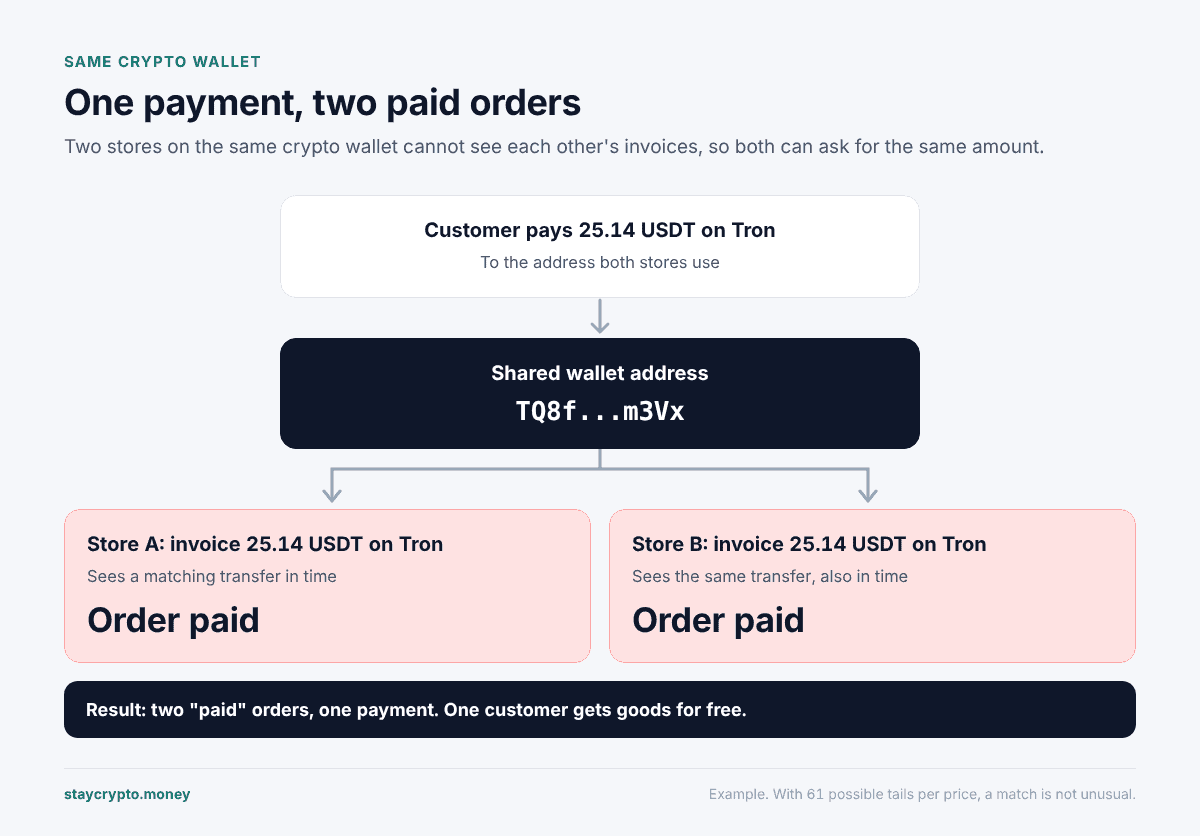
You now have two “paid” orders and one payment. One customer gets goods for free, and you only find out when you reconcile. The plugin cannot prevent this, because neither copy can see the other’s reservations. The readme says so in its FAQ.
There is a quieter version too. Store B’s customer pays a slightly wrong amount, which happens to equal an open invoice in store A. Store A closes its order on someone else’s money.
The staging trap
A staging or development copy is a second store. If you clone your live shop to test a theme update, the clone carries the same wallet addresses and the same plugin settings. If it has open orders (copied from production, or test orders you placed), its scanner reads the same addresses and can match real customer payments to fake orders.
Worse, it can go the other way: a test order on staging gets “paid” by a live customer’s transfer, and the plugin on staging records it, sends a Telegram message to the same chat, and confuses everyone.
Before you start a cloned site:
- Disable the StayCrypto payment method on the copy, or
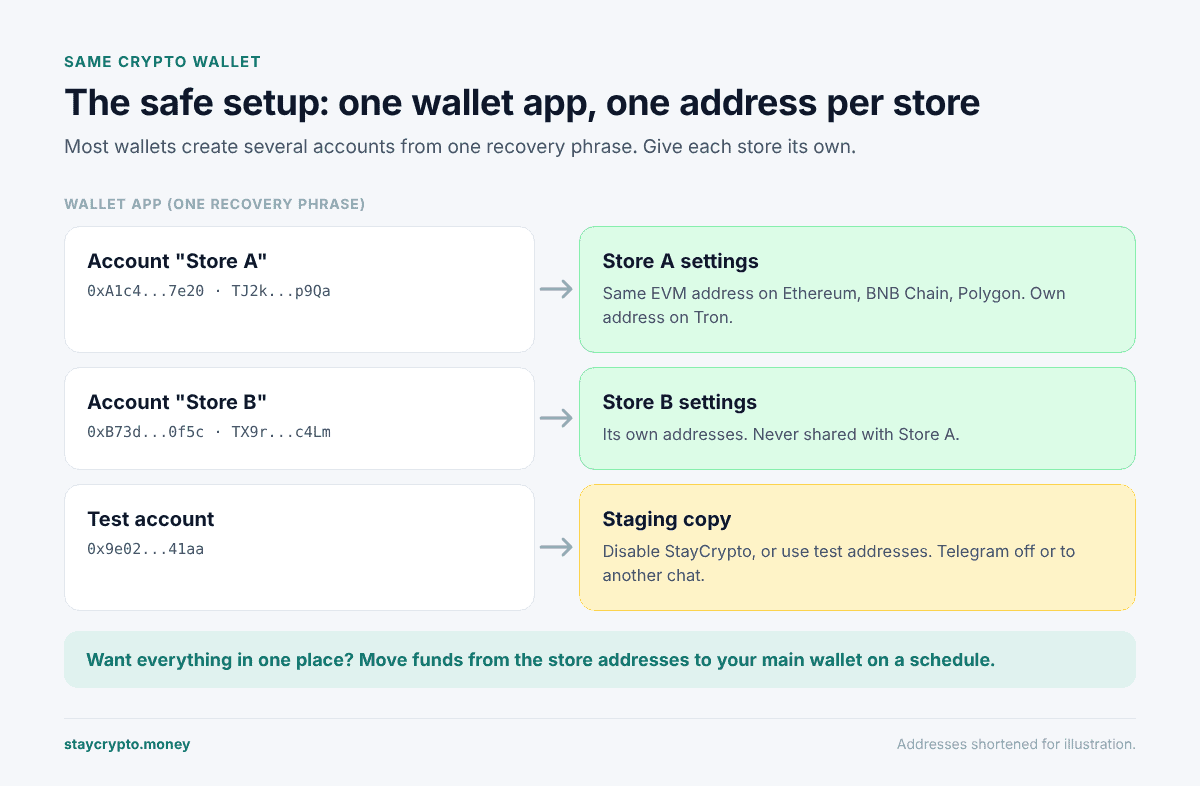
- Replace the wallet addresses on the copy with test addresses you control and never use in production.
Also turn off Telegram on the copy or point it at a different chat, so alerts from staging do not look like alerts from your shop. If your host offers one-click staging, do this immediately after creating it.
Personal transfers to the store address
The same logic applies to your own transfers. If you send money to the store address from your exchange, and the amount happens to match an open invoice, the plugin will treat it as that customer’s payment. If it is close but not exact, it ends up as a flagged payment on an order or on the Unassigned list, and you will have to sort it out.
Keep the store address for store payments only.
What is safe
One EVM address across Ethereum, BNB Chain and Polygon is fine. The three networks use the same address format, and plenty of stores use one address for all three. The plugin reads each network separately and checks each token by its contract. USDT on Polygon and USDT on BNB Chain never get mixed up, because they are different tokens on different chains.
Tron needs its own address in any case, since its format is different.
Several stores, each with its own addresses, all owned by you, is fine. Most wallets can create several accounts from one recovery phrase. You still keep everything in one wallet app. Each store just gets its own account.
Setting it up properly
- In your wallet, create one account (address) per store. Name them by store.
- In each store’s StayCrypto settings, paste that store’s address for every network you accept. Paste from the wallet’s receive screen, not from history (why that matters).
- If you want the money in one place, move it from the store addresses to your main wallet or exchange on a schedule. That is a normal outgoing transfer and does not affect matching.
- For accounting, each address now equals one store, which is easier to reconcile anyway.
Already using the same crypto wallet on two stores?
Fix it in a quiet moment:
- Wait until neither store has open crypto invoices, or at least plan the change outside your busy hours.
- Give one of the stores a new address. Only an administrator can change it, and the plugin will log the change and send a Telegram warning.
- After the change, keep an eye on the old address in the explorer for a day or two. StayCrypto watches only the current address, so a customer who had a payment page open before the change might still pay the old one. Any such payment has to be matched by hand.
- Go back through recent orders in both stores and compare them with the transactions on the shared address. Look for any transfer that paid two orders.
For more on keeping the store wallet safe, read crypto wallet security for an online store.
FAQ
What is the actual chance of a collision?
It depends on how often both stores have open invoices at similar prices on the same network. On two busy stores it is not rare. The point is that it cannot be detected by either store, so even a small chance becomes a real loss sooner or later.
Can the plugin warn me if two stores use the same crypto wallet?
No. Each installation sees only its own database. Nothing connects them, which is the point of a self-hosted plugin.
Can two stores share one Telegram chat?
They can, but messages will be harder to tell apart. If you do it, give each bot a clear name.
Is it safe to reuse the store address for receiving payments from a marketplace or a client?
It is better not to. Any incoming transfer near an open invoice amount can be taken as a customer payment.
Does the same apply to a multisite network?
Treat each shop on a multisite network as a separate store with its own address.