You picked a crypto payment gateway because the pricing page said something clean and simple. “1% per transaction.” “0.5%, no hidden fees.” Then a few weeks in, you compare what customers paid against what actually landed in your wallet, and the numbers don’t match. Nobody stole anything. There is a hidden spread in crypto payment gateways that almost never shows up on the pricing page, and once you know where to look, it’s easy to spot.
The number on the pricing page is not the number you pay
Payment processors, crypto or not, have every incentive to advertise the smallest number that’s technically true. A “1% processing fee” is real, but it’s rarely the only thing you’re paying. On top of it there can be a conversion spread, a fiat withdrawal fee, network costs, and sometimes an optional markup that gets switched on by default.
None of this is illegal or even unusual. Payment processing has worked this way for decades, card networks do the same thing with interchange fees. The problem is that crypto gateways market themselves on transparency and “no hidden fees,” while the actual cost structure is anything but obvious unless you read the fee documentation line by line.
Where the hidden spread in crypto payment gateways comes from
Break a crypto payment into layers and you’ll usually find four.
First, the processing fee. That’s the headline number, what the gateway charges for handling the transaction itself.
Second, the conversion spread. If the gateway converts the customer’s crypto into a stablecoin or fiat on your behalf, it buys at one rate and credits you at a slightly worse one. This is standard practice in currency exchange, and gateways rarely disclose it as a specific percentage. A breakdown of gateway fee structures by Amboss puts typical conversion spreads around 0.3% to 0.8%, more for less liquid coins.
Third, the fiat off-ramp fee. Want euros or dollars in your bank account instead of crypto? That conversion usually costs extra, and this is often where the biggest hidden cost sits.
Fourth, the network fee. The blockchain itself charges to move funds. That has nothing to do with the gateway and varies by chain and congestion, but some gateways pass it to you in ways that aren’t obvious at checkout.
Stack the processing fee, the spread, and an off-ramp charge, and a “1%” gateway can easily cost you close to 2% in practice.
What this looks like with real numbers
The hidden spread in crypto payment gateways is easiest to see once you line up two well-known providers side by side.
Take NOWPayments. Their standard service fee is 0.5%, rising to 1% for multi-currency or fixed-rate payments. That part is genuinely competitive. But the dashboard also has a “payment markup” setting that can add up to 10% on top, meant to shift network costs onto the customer, and depending on how a store owner configures it, that markup can end up baked into checkout without the buyer realizing why the price moved.
CoinGate charges a flat 1% on its standard merchant plan, which is straightforward. Where it adds up is on the edges: withdrawing to fiat currency can run 2% to 4% depending on the payout method, and currency conversion carries its own spread on top of the base fee.
Neither company is doing anything shady. It’s all in their documentation if you go looking. The issue is that “1%” is what shows up in comparison articles and marketing copy, and the rest lives three clicks deep in a fees page most merchants never open before signing up.
A $100 payment, walked through
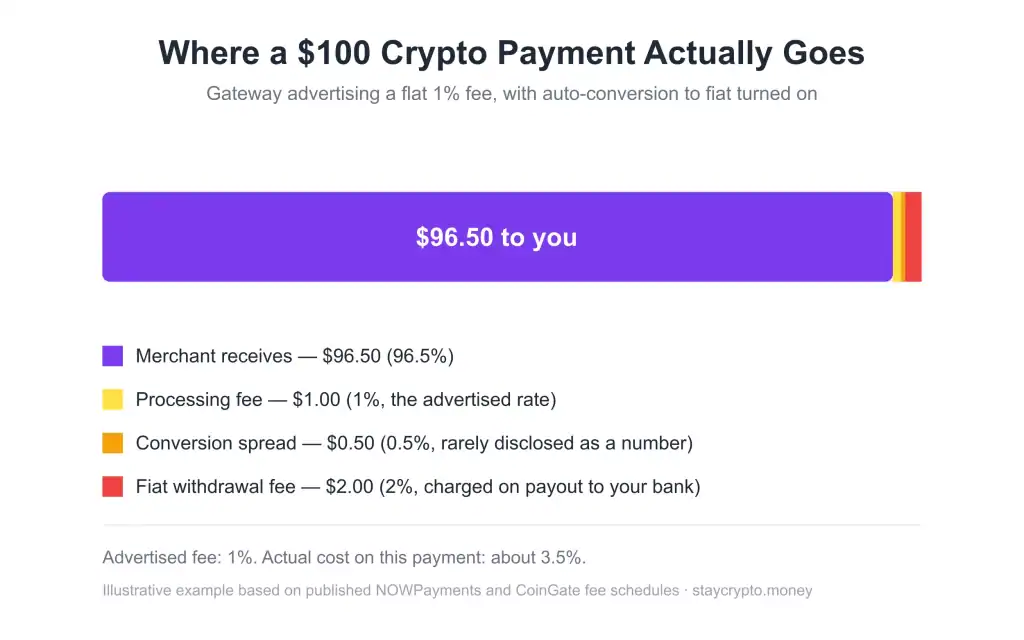
Say a customer pays $100 in crypto through a gateway advertising a 1% fee, with auto-conversion to your local fiat currency turned on.
- Processing fee at 1%: you lose $1
- Conversion spread at roughly 0.5%: another $0.50
- Fiat withdrawal fee at 2%: another $2
You’re now at roughly $96.50 landing in your account from a $100 sale, against an advertised “1% fee.” That’s not a scandal, it’s just how layered pricing works when conversion and settlement are involved. But it explains why merchants comparing gateways purely on the headline percentage keep getting surprised.
Why non-custodial changes the math
StayCrypto works differently, and it’s worth saying plainly why, without pretending it makes it “better” for everyone.
With a non-custodial setup, the plugin never holds your funds and never converts them. The customer sends USDT or USDC directly from their wallet to yours, on BNB Chain, Polygon, Tron, or Ethereum. There’s no intermediary step where a spread can get applied, because there’s no conversion happening at all. The only cost is the network fee the blockchain itself charges, which the plugin doesn’t touch or mark up.
That’s a structural difference, not a promotional one. It also means you’re the one holding stablecoins instead of local fiat, which is a real tradeoff: no auto-conversion, no built-in off-ramp, you handle that separately if you need fiat. Custodial gateways exist because plenty of merchants want that conversion handled for them and are willing to pay for it. Non-custodial makes sense if you’re comfortable holding stablecoins or converting them yourself, and you’d rather not pay a spread you can’t see for a service you didn’t ask for. If you’re still weighing which model fits your store, the tradeoffs between custodial and non-custodial payment gateways go deeper than just fees.
Five questions worth asking any gateway before you connect it
- Is the advertised percentage the total cost, or just the processing fee?
- What’s the spread on crypto-to-fiat or crypto-to-stablecoin conversion, and is it published anywhere as a number?
- Is there a separate fee to withdraw to a bank account, and how much?
- Who pays the network fee, you or the customer, and is that configurable?
- Are there default settings (like a markup toggle) that could be adding cost without your knowledge?
If a gateway can’t answer the second and third questions with a specific number, that’s the answer.
The takeaway
The hidden spread in crypto payment gateways isn’t a scam, it’s just left out of the marketing copy. Crypto payment gateways aren’t lying when they advertise a low headline fee. They’re just leaving out the parts of the bill that live somewhere else. Before you pick one, add up processing, spread, and off-ramp costs for your actual use case, not the number on the homepage. And if you don’t need fiat conversion at all, it’s worth checking whether you need that layer of fees in the first place. StayCrypto is free to set up on a WooCommerce store if you want to see what a zero-spread checkout looks like.