Most crypto payment gateways still put a company between your customer and your wallet. The customer pays the gateway, the gateway converts or holds the funds briefly, then the gateway pays you. Crypto payments without a third party skip that middle step entirely. The money moves from the customer’s wallet to yours, on-chain, and nothing else touches it in between. That sounds like a small technical detail. It changes more than it looks like it would.
What “third party” actually means here
In a typical gateway, the third party is the company running the payment infrastructure. They generate the invoice, receive the customer’s crypto into an account they control, sometimes convert it to another asset or to fiat, and then send you the result, minus their fee. For that window, however short, they’re holding funds that are technically yours.
This isn’t a scam or a red flag. It’s just how most payment infrastructure works, crypto or not. Card processors hold funds between authorization and settlement too. The difference with crypto is that skipping the intermediary is actually possible, because the underlying technology already supports direct transfers.
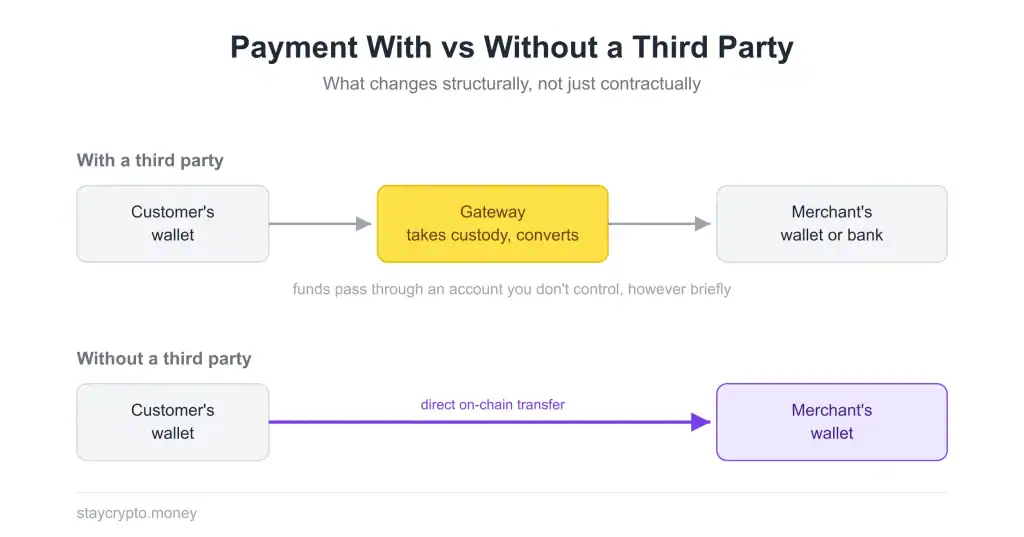
What changes technically with crypto payments without a third party
With crypto payments without a third party, the flow is: customer’s wallet sends USDT or USDC directly to your wallet address, on a network like BNB Chain, Polygon, Tron, or Ethereum. A plugin like StayCrypto still handles the parts that need automating: generating a unique amount so the payment can be matched to the right order, watching the blockchain for confirmation, and updating the order status in WooCommerce. What it doesn’t do is sit in the middle of the money.
There’s no account balance held anywhere except your own wallet. No withdrawal step, because there was never a deposit into someone else’s system to withdraw from.
What you gain
- No counterparty risk. If a custodial gateway has an operational problem, gets hacked, or freezes an account for review, funds sitting in their system are exposed to that. Funds that never left a customer’s wallet except to go directly to yours were never exposed to begin with.
- No business verification. Custodial services generally require it, sometimes at signup, sometimes once your volume crosses a threshold, because they’re the ones holding funds and taking on regulatory responsibility for that. Skip the intermediary and there’s no custody relationship to verify.
What you give up
- No automatic fiat conversion. You receive stablecoins, not euros or dollars in a bank account. If your business needs that, you’re either converting manually through an exchange or better served by a custodial gateway that includes it.
- More responsibility for recordkeeping. A custodial gateway typically gives you a dashboard with transaction history built in. Without one, you’re relying on the blockchain itself and whatever your plugin logs, which works fine but takes more initiative on your end.
This isn’t a strictly better setup, it’s a different one.
Who this fits
If you’re comfortable holding stablecoins, or you have your own process for converting them, and you’d rather not have any company sitting between your customer’s payment and your wallet, this model fits. If you need automatic fiat settlement or you’re not ready to manage crypto directly, a custodial gateway is doing a job you’d otherwise have to do yourself, and paying for that is a reasonable tradeoff.
For WooCommerce stores specifically, crypto payments without a third party show up at checkout as a simpler flow: the customer pays, the plugin watches for the matching on-chain transaction, and the order updates once it confirms. No redirect to a third-party payment page, no account with an external company involved at any point.
Frequently asked questions
Is it legal to accept crypto payments without a third party?
Yes, in most jurisdictions. You’re receiving funds directly into a wallet you control, the same way you’d receive any other form of payment. Tax and reporting obligations still apply, they just don’t run through a payment processor’s paperwork. Check the specifics for your own country.
What happens if a transaction fails when there’s no third party involved?
The transaction either confirms on-chain or it doesn’t, there’s no intermediate “processing” state controlled by a company. If a customer sends the wrong amount or to the wrong network, a plugin that watches the blockchain directly, like StayCrypto, can flag the mismatch, but there’s no support ticket to file with a processor because there was never a processor holding the funds.
Do I still need a payment plugin if there’s no third party?
Yes. Removing the custodial intermediary doesn’t remove the need for something to generate a unique payment amount, watch the blockchain for confirmation, and update your WooCommerce order. The plugin automates that without ever taking custody of the funds itself.
Can I convert crypto to fiat later if I accept payments without a third party?
Yes, you just do it as a separate step, through an exchange, on your own schedule, instead of having it happen automatically at the moment of sale.
Is accepting crypto without a third party safe for beginners?
It’s straightforward once set up, since the plugin handles the technical matching and confirmation. The part that takes more initiative is holding and eventually converting stablecoins yourself, since there’s no built-in dashboard managing that for you the way a custodial gateway would.