On Polygon there are two different tokens that most wallets simply call “USDC”. One is native USDC, issued on Polygon by Circle. The other is USDC.e, an older bridged version that was moved over from Ethereum. Both are legitimate, both track the dollar, and they are separate tokens with separate contracts. If you accept USDC on Polygon, you will eventually receive both, so the USDC vs USDC.e question will reach you sooner or later.
Table of Contents
StayCrypto accepts both on Polygon and tells you which one arrived. Here is what that means in practice.
Where the two tokens came from
Before Circle issued USDC directly on Polygon, the only way to get USDC there was a bridge: you locked USDC on Ethereum and received a token on Polygon that represented it. That bridged token is what wallets and explorers now label USDC.e (sometimes “USDC (PoS)”).
Later, Circle launched native USDC on Polygon. It is minted and redeemed by Circle on Polygon itself, without a bridge in between. Most new activity moved to the native token, but USDC.e did not disappear. Plenty of wallets and exchanges still hold it and send it.
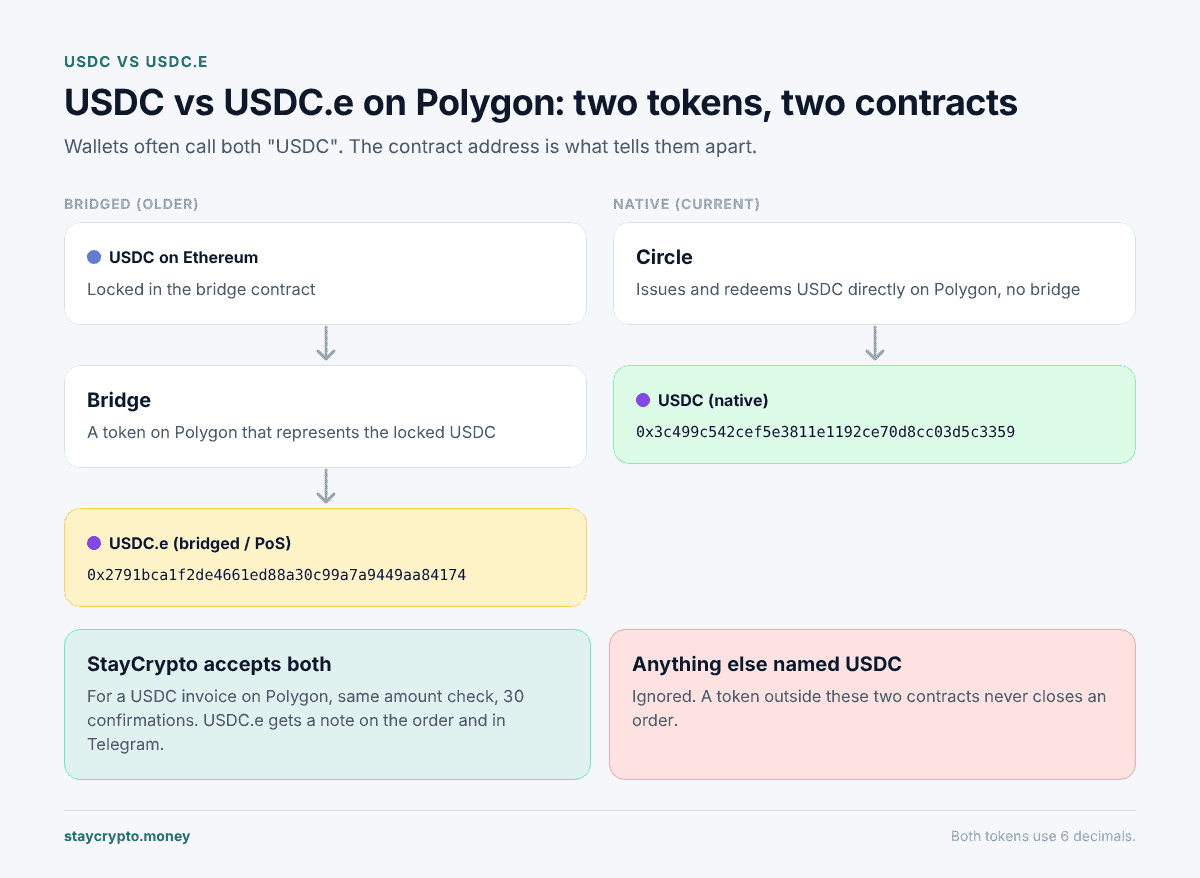
USDC vs USDC.e: the contracts
The name in a wallet is just a label anyone can set. The contract address is what identifies a token. These are the two StayCrypto watches on Polygon:
| Token | Contract on Polygon |
|---|---|
| USDC (native) | 0x3c499c542cef5e3811e1192ce70d8cc03d5c3359 |
| USDC.e (bridged) | 0x2791bca1f2de4661ed88a30c99a7a9449aa84174 |
Both use 6 decimals. Any other token called “USDC” on Polygon is not one of these, and the plugin will not count it as payment, whatever the wallet shows.
3 easy ways to tell USDC vs USDC.e apart
In the order. When a payment in the bridged token is matched, StayCrypto adds a line to the order note: “Paid in USDC.e (bridged/PoS), not native USDC”. The same remark appears in the Telegram message if you have notifications set up. Native USDC payments carry no such remark.
In the explorer. Open the transaction on PolygonScan and look at the token transfer section, not only at the token name. Click through to the token and compare the contract with the table above.
In your wallet. Many wallets list them as two separate lines, sometimes both reading “USDC”. If your balance looks split, that is why. Nothing is missing.
Does USDC vs USDC.e matter to your store?
For the order itself, no. The plugin treats both as payment for a USDC invoice on Polygon, with the same amount check and the same 30 confirmations before the payment counts.
It matters later, when you move the money:
- Exchanges. Some exchanges accept deposits of only one of the two on Polygon, or list them under different names. Sending the wrong one to an exchange that does not support it can mean a support ticket and a wait. Check the deposit page for the exact network and token before you send.
- Swapping. If you want everything in one token, you can swap USDC.e to native USDC in a wallet or on an exchange that supports both. Expect a small swap cost and network fee.
- Accounting. If you track balances per token, keep the two apart.
None of this is a reason to stop accepting USDC on Polygon. It is a reason to know which token is sitting in your wallet before you send it anywhere.
Why the plugin accepts both
Rejecting USDC.e would punish customers who did nothing wrong. Their wallet showed USDC, they picked USDC on your payment page, and they sent the right amount. Turning that into a disputed payment helps nobody. Accepting it and marking it clearly gives you the information without blocking the sale.
The rule is narrow, though. It covers these two contracts on Polygon only. It does not mean the plugin accepts “anything called USDC”.
While we are on lookalike tokens
The same lesson applies elsewhere. A ticker is not proof:
- USDT on Tron and USDT on Ethereum are different tokens on different networks. Money sent on the wrong network does not reach the plugin. See the network comparison for which networks to switch on.
- USDC on Tron is not accepted at all. StayCrypto takes USDT only on Tron.
- Fake tokens with a familiar name do exist. A transfer of a token that is not one of the watched contracts is simply ignored. It never closes an order.
For the wider choice between the two main stablecoins, read USDT vs USDC for merchants.
FAQ
Is USDC.e a scam or a fake token?
No. It is a legitimate bridged version of USDC. It is just a different token from native USDC, with its own contract.
My customer paid with USDC.e. Do I need to do anything?
No. If the amount matched, the order completed as usual. The note on the order only tells you which token arrived.
Can I accept only native USDC on Polygon?
Not as a setting in the current version. Both contracts are accepted for USDC on Polygon.
USDC vs USDC.e: which one is worth more?
Both aim at one dollar. Prices on exchanges can differ slightly at times, which is another reason to check what you hold before swapping or selling.
Does the same split exist on BNB Chain or Ethereum?
The plugin watches one USDC contract on Ethereum and one on BNB Chain. The bridged-versus-native distinction it marks is specific to Polygon.