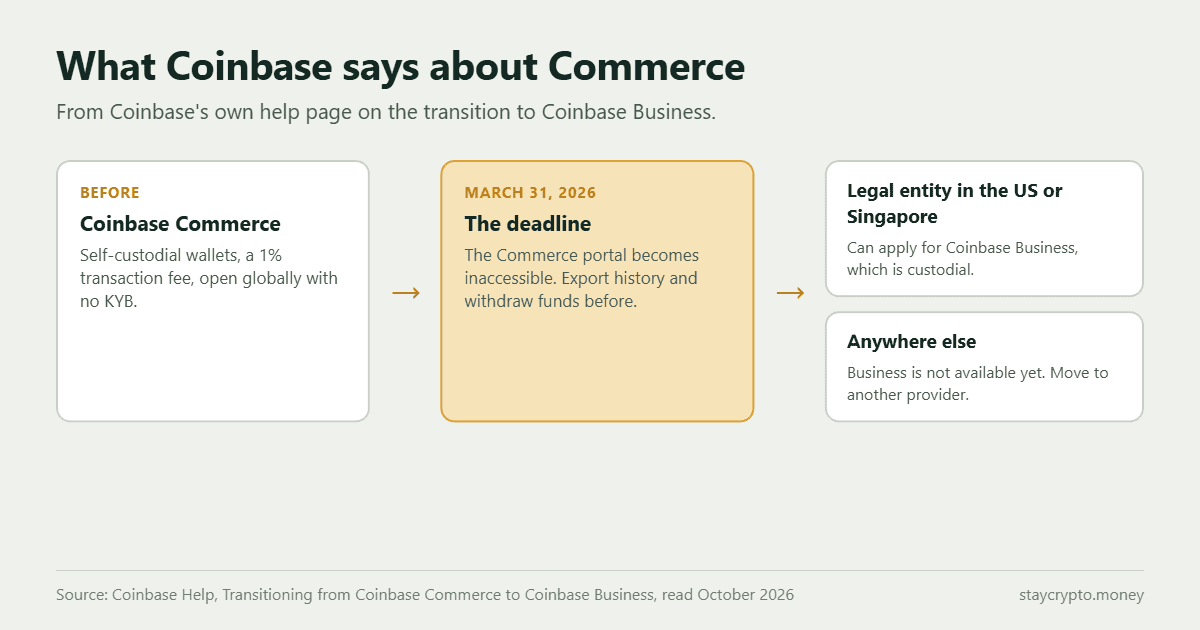
Coinbase Commerce closed on March 31, 2026. Coinbase’s own help page says merchants had to transition by that date, and that after it the Commerce portal would become inaccessible. Merchants in the United States and Singapore could move to Coinbase Business, which is custodial. For merchants elsewhere, Coinbase says Business was not available and they needed another provider. Here’s the short version for a WooCommerce store: StayCrypto does the same core job (crypto straight to your own wallet, no middleman) but as a plugin that runs on your own site, not as a hosted service. The plugin doesn’t route payments through our servers, because we don’t run payment servers.
Table of Contents
The rest of this post is the long version: what Coinbase says happened, why custody structure matters, and what’s different about how StayCrypto is built.
What Coinbase says happened
Everything in this section comes from Coinbase’s help page Transitioning from Coinbase Commerce to Coinbase Business, read in October 2026.
- Coinbase Commerce is being unified with Coinbase Business. Merchants had to complete the transition by March 31, 2026, after which the Commerce portal became permanently inaccessible.
- Coinbase Business is described as a custodial platform with bank off-ramps, accounting integrations and stablecoin payments. It is open to businesses with a legal entity in the United States or Singapore, and Coinbase says it is expanding to more countries during 2026.
- Merchants outside those two countries were told to move to an alternative provider before the deadline, and to export their transaction history and withdraw their funds first.
- Commerce wallets were self-custodial: Coinbase says it never had the seed phrase and could not recover funds for anyone who lost it.
- Coinbase’s stated reason: Commerce was built for an earlier phase of crypto, and businesses now expect custody, compliance and cash-out tools.
| Coinbase Commerce (closed) | Coinbase Business | |
|---|---|---|
| Fee | 1% transaction fee | 1% for migrating merchants |
| Networks | Ethereum, Polygon, Base | Coinbase lists all five major EVM networks |
| Custody | Self-custodial | Custodial |
| Assets | Hundreds of assets | USDC only at the time of the page; USDT coming |
| Who can use it | Open globally, no KYB | Businesses in the US and Singapore |
Source: the same Coinbase help page.
Why custody structure isn’t a technicality
This isn’t just a StayCrypto talking point. It’s been tested at scale, twice, in ways that produced very different outcomes depending on exactly this detail.
When Celsius Network froze withdrawals in June 2022 and filed for bankruptcy that July, what happened next depended on account type. Customers who’d used custody accounts, where Celsius never took ownership of the assets, mostly got their coins back in kind. Customers on Earn accounts, where Celsius took ownership of deposits in exchange for interest, became unsecured creditors instead, with a much rougher path to recovery. FTX collapsed a few months later, in November 2022, with the same underlying issue: customer funds weren’t segregated the way people assumed.
Neither of those was a WooCommerce payment gateway. But the lesson transfers directly: whether a platform legally holds your funds, even briefly, decides what happens to you when that platform has a bad year.
Where StayCrypto is built differently
StayCrypto isn’t a service you have an account with. It’s a WooCommerce plugin, installed once, running on your own server. It doesn’t route payments through us: it reads the public blockchain and watches for a transfer to the wallet address you typed in yourself.
If we disappeared tomorrow, every order that already happened stays exactly as settled, because the money never touched our infrastructure in the first place. The plugin is open source under the GPL license, so someone else could keep the code alive even if we didn’t. It does rely on public blockchain nodes, and on exchange-rate sources if your store isn’t priced in US dollars. You can enter a node of your own.
That’s the difference between non-custodial as a feature you advertise and non-custodial as the thing your whole architecture is built around. Coinbase says Commerce wallets were self-custodial too, but the Commerce portal ran on Coinbase’s side and Coinbase closed it. A plugin on your own server has no such switch.
How the matching actually works
Every order gets its own payment amount, even though the receiving wallet address stays the same for every order. The plugin takes the order total in US dollars, rounds it up to the next cent, and adds a small unique extra of 0 to 60 cents. StayCrypto watches the blockchain through several independent public RPC providers per network, so one provider’s downtime doesn’t stop payment detection. Once a payment arrives, it waits for network confirmations before trusting it (12 blocks on Ethereum, 15 on BNB Chain, 20 on Tron, 30 on Polygon) as protection against a rare chain reorganization undoing it. If the amount matches exactly, the order closes on its own. If it doesn’t, it’s held for manual review instead of guessed at. See the documentation for the full breakdown.
Side by side
| Coinbase Commerce (closed) | StayCrypto | |
|---|---|---|
| Fee | 1% transaction fee (Coinbase) | No service fee. Only the blockchain network fee |
| Custody | Self-custodial wallets (Coinbase) | No custody. Payments go from the buyer’s wallet to yours |
| Networks | Ethereum, Polygon, Base (Coinbase) | BNB Chain, Polygon, Ethereum, Tron |
| Assets | Hundreds of assets (Coinbase) | USDT and USDC (USDT only on Tron) |
| Where it runs | Coinbase’s Commerce portal | Your own WooCommerce store |
| Status | Closed on March 31, 2026 | Download on our plugin page; WordPress.org listing in preparation |
One honest caveat
Coinbase’s page says Commerce supported hundreds of assets. StayCrypto covers four networks and two stablecoins because that’s what the code handles well, not because the list can grow the moment a new coin gets popular. If your business needs a long tail of niche tokens, that’s a real tradeoff, and we won’t pretend otherwise.
Migrating to a Coinbase Commerce alternative
If you’re moving off Coinbase Commerce, the setup is a familiar shape: install the plugin, enter a wallet address per network, done. No account with us, no API key, no dashboard you have to log into to see your own money. StayCrypto is not in the WordPress.org directory yet, but you can download it from the plugin page. Switching only changes how new orders get paid. Coinbase said Commerce and Coinbase Business are separate systems and that Commerce history would not transfer, so keep the records you exported.
FAQ
Is StayCrypto a replacement for Coinbase Commerce specifically, or just similar?
It solves a similar problem (crypto payments straight to your wallet, no custodial middleman) but as a self-hosted WooCommerce plugin instead of a hosted service. There’s no account and no company dashboard to be discontinued.
What happens to my Coinbase Commerce history and funds?
According to Coinbase’s help page, Commerce and Coinbase Business are separate systems and history does not transfer. Merchants were told to export their history and withdraw funds before March 31, 2026, because the withdrawal tool would be permanently disabled. If you still have funds there, read that page and contact the support address it lists.
Does StayCrypto charge a percentage like Coinbase Commerce did?
No. StayCrypto is free and open source under the GPL license, with no per-transaction fee. Coinbase’s page lists a 1% transaction fee for Commerce.
Which cryptocurrencies does StayCrypto support?
USDT and USDC on Ethereum, BNB Chain and Polygon, plus USDT on Tron.
Can I still use Coinbase Business?
Coinbase says Business is available to businesses with a legal entity in the United States or Singapore, and that it is custodial. Check Coinbase’s page for the current list of countries.