USDT vs USDC comes down to this: both aim to be worth exactly one US dollar, but USDT is widely used for transfers, especially on Tron, while USDC is the one issued under the EU’s MiCA rules, which can make it easier to cash out in the EU. For most online stores the honest answer is to accept both, and this article explains why and where the differences actually matter.
Table of Contents
What USDT and USDC are
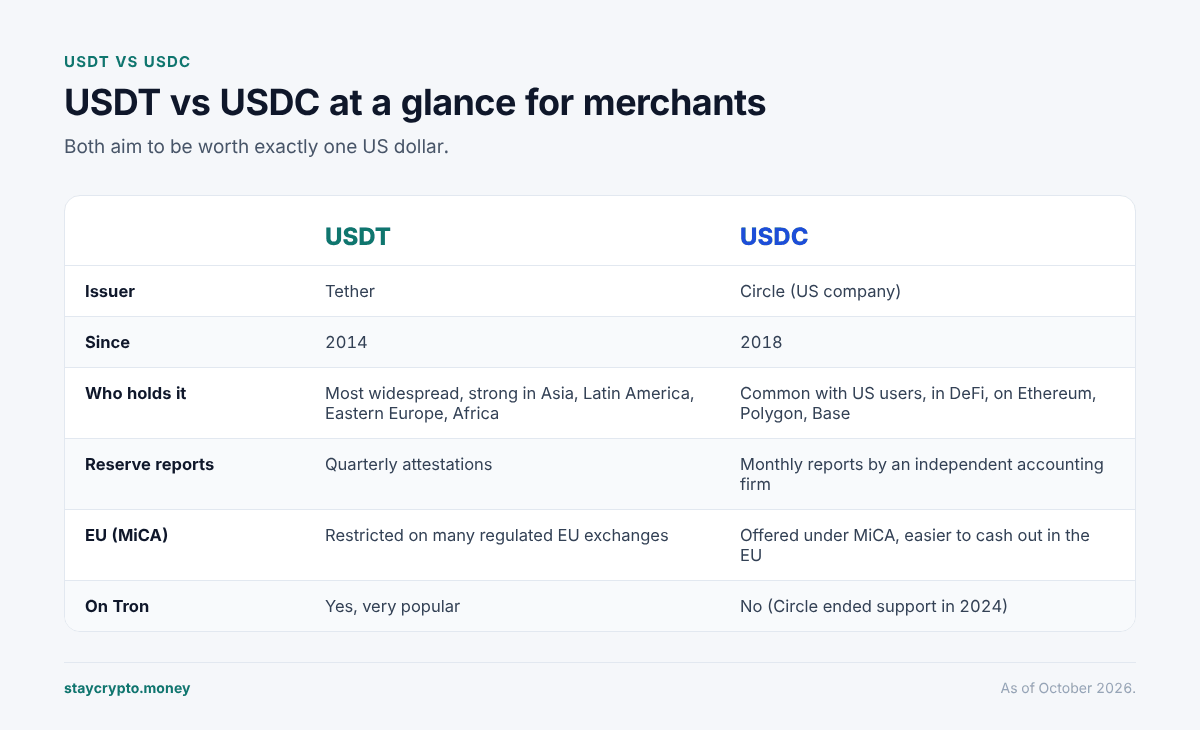
Both are stablecoins: tokens on a blockchain that are backed by reserves and designed to hold a 1:1 value with the dollar. You can send them like any crypto, quickly and at any hour, without the price moving between checkout and payment.
- USDT (Tether) is issued by Tether. It has been around since 2014 and is one of the two largest stablecoins.
- USDC (USD Coin) is issued by Circle, a US company. It launched in 2018.
For a store, a stablecoin removes the main problem of taking Bitcoin: a $50 order is still worth $50 when it reaches your wallet.
Difference 1: who already holds them
USDT is widely used for transfers, especially on the Tron network, where transfers are usually cheap. If your customers pay from exchange accounts, many of them may reach for USDT first.
USDC is available on networks such as Ethereum, BNB Chain and Polygon. In the USDT vs USDC choice, the customer’s wallet often decides for you.
Difference 2: transparency and reserves
Both issuers publish reserve information: see the Circle transparency page and the Tether transparency page. Tether says its tokens are backed by its reserves. These are the issuers’ statements, and we did not audit them.
Read the reserve details yourself before you decide how much of either coin to hold, because what each issuer holds can change.
Neither is a bank deposit. “Stable” describes the goal, not a guarantee. For a store that converts its takings regularly, the practical risk is low, but it is one reason some businesses prefer not to hold large balances in a single stablecoin for long.
Difference 3: regulation, especially in the EU
This is where USDT vs USDC differs most in 2026.
In the European Union, the MiCA regulation sets rules for stablecoin issuers. In July 2024 Circle said it had obtained an e-money institution licence in France that, in its words, lets USDC be issued under MiCA (Circle press release). Tether has not announced a MiCA authorization, and since late 2024 several regulated exchanges, including Coinbase and Crypto.com, have restricted USDT for EU customers. Reports differ on the exact dates.
What this means for you: if you sell in the EU and plan to convert your crypto on an EU exchange, USDC may be easier to cash out. USDT can still be received in your own wallet, but you may need to swap it or use a non-EU service to sell it. Check with the exchange you use.
Difference 4: networks
Both tokens exist on many blockchains, but not the same ones in the same way:
| Network | USDT | USDC |
|---|---|---|
| Ethereum | Yes | Yes |
| BNB Chain | Yes | Yes |
| Polygon | Yes | Yes (native and bridged USDC.e) |
| Tron | Yes, very popular | No longer supported by Circle since 2024 |
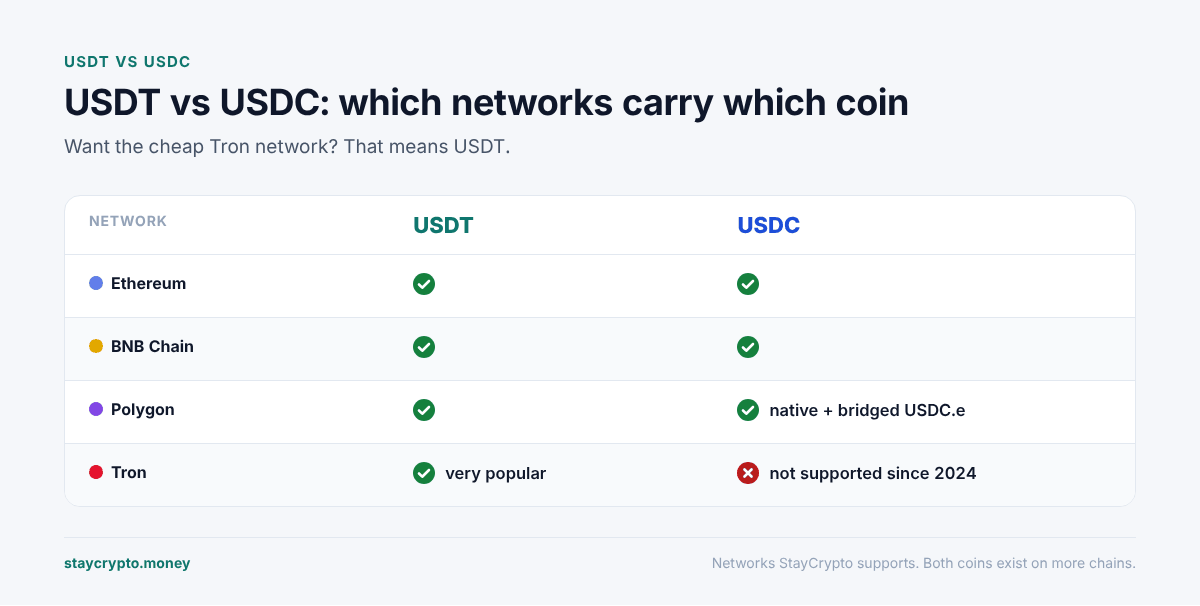
Circle stopped supporting USDC on Tron in 2024. If you want to accept the cheap Tron network, that means USDT. On Polygon, watch out for two different USDC tokens; our guide on USDC vs USDC.e explains how to tell them apart.
Difference 5: cashing out and accounting
Both convert to dollars or euros on major exchanges. The differences are mostly local: which stablecoin your bank-connected exchange supports, and whether it is allowed in your region.
For bookkeeping, many accountants treat a dollar stablecoin as a digital asset rather than cash. The rules depend on your country, so ask yours how to record it (our general guide to the legal side).
USDT vs USDC: which should your store accept?
| If your situation is… | Accept |
|---|---|
| International customers, emerging markets | USDT first, USDC as well |
| Mainly EU customers, EU bank and exchange | USDC first, USDT as well |
| You want the cheapest network (Tron) | USDT |
| You plan to hold balances for a while | Consider USDC, and do not hold too much in one coin |
Accepting both costs you nothing extra in most setups. StayCrypto lets the customer pick the coin on the payment page, so you do not have to guess. For the bigger picture, see our guide to stablecoin payments for online stores, and to compare plugins, read WooCommerce crypto payment plugins compared.
FAQ
Is USDT or USDC safer?
Both publish reserve information, and Circle says USDC is issued under MiCA in the EU. USDT has been around longer. Neither carries a government guarantee. Many businesses accept both and convert regularly.
Can a customer pay a USDT invoice with USDC?
Not interchangeably. They are different tokens with different contracts. A payment in the wrong one will not match the invoice automatically, even if the amount is right.
Which has lower fees?
The token does not set the fee; the network does. USDT on Tron and either token on Polygon or BNB Chain are cheap to send. Either token on Ethereum costs more.
Is USDT banned in Europe?
Holding or receiving it is not banned. Under MiCA, several EU exchanges stopped offering USDT trading to EU customers. Selling it may be harder inside the EU.
Do I need separate wallets for USDT and USDC?
No. The same wallet address on a given network can receive both. They show up as separate balances.