For most stores the cheapest network to accept USDT is Polygon or BNB Chain, not TRON, and definitely not Ethereum. That will surprise anyone who has been told for years that TRC-20 is the cheap option. It used to be true in a straightforward way. It is now true only under conditions that most merchants do not meet.
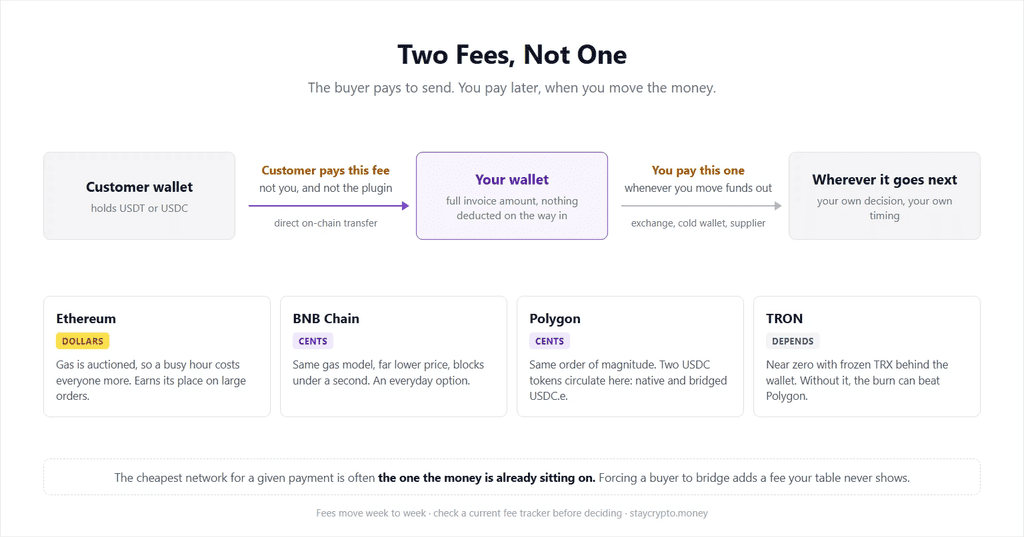
The confusion comes from a second question hiding inside the first one: cheap for whom. A blockchain fee is paid by whoever sends the transaction, so the fee on an incoming payment is the customer’s problem, not yours. Your own fee arrives later, when you move that money somewhere else. Pick a network by looking at both.
In this guide:
- Two different fees, not one
- How each network charges
- The cheapest network to accept USDT, side by side
- Why TRON’s cheap reputation is only half true
- Speed is a cost too
- Which networks to switch on in your store
Two different fees, not one
When a customer pays you in USDT, they pay the network fee for that transfer. You receive the full invoice amount. Nothing is deducted on the way in, which is one of the quieter differences between a direct wallet payment and a processor that skims a percentage before forwarding the rest. On a non-custodial gateway such as StayCrypto, the amount that lands in your wallet is the amount on the invoice.
Your cost shows up in two other places. First, when you move funds out of the store wallet, to an exchange, to a cold wallet, to a supplier. Second, in lost sales, because a customer who sees a several-dollar fee on a small order sometimes just closes the tab. That second cost is invisible in your accounts and often larger than the first.
So the practical question is not “which chain has the lowest number” but “which chain is cheap for the buyer to send on and cheap for me to consolidate from later.”
How each network charges
Ethereum (ERC-20)
Gas is auctioned. When the network is busy the price goes up for everyone, and a token transfer costs several times what a plain coin transfer costs, because the token contract does more work. It is the expensive option and it is not close. Ethereum earns its place for large payments, where a fee of a few dollars is noise against the order value, and for buyers who already hold their funds there and do not want to bridge.
BNB Chain (BEP-20)
Same gas model as Ethereum, far lower gas price, blocks under a second. Transfers cost a fraction of a cent to a few cents in normal conditions, and wallets and exchanges support it almost everywhere.
Polygon
Also EVM, also cheap, roughly the same order of magnitude as BNB Chain. One detail is specific to Polygon: there are two USDC tokens in circulation, native USDC and the older bridged USDC.e. They are separate contracts. A gateway that watches only one of them will miss payments in the other, which is a genuine source of “the money is right there on the explorer and the order says unpaid”. StayCrypto recognises both.
TRON (TRC-20)
A different model altogether. TRON gives accounts energy and bandwidth, which regenerate over time and can be increased by freezing TRX. A sender with enough energy pays effectively nothing. A sender without it burns TRX to cover the transfer, and that burn cost has climbed a lot over the years. A casual wallet with no frozen TRX can end up paying more on TRON than on Polygon or BNB Chain for the same USDT.
Exact numbers change week to week and there is no honest way to print them in an article that will still be read a year from now. Check the chain’s own block explorer before you make a decision that matters: Etherscan, BscScan, PolygonScan and Tronscan all show recent transactions with the fee each one paid.
The cheapest network to accept USDT, side by side
| Ethereum | BNB Chain | Polygon | TRON | |
|---|---|---|---|---|
| Fee model | gas auction | gas, low price | gas, low price | energy and bandwidth, or burned TRX |
| Typical cost to send | dollars | cents or less | cents or less | anywhere from near zero to several dollars |
| Predictable | no | yes | yes | depends on the sender’s account |
| Coins in StayCrypto | USDT, USDC | USDT, USDC | USDT, USDC and USDC.e | USDT |
| Confirmations waited for | 12 | 15 | 30 | 20 |
| Real wait | longest | seconds | seconds | seconds |
| Best for | large orders, buyers already on ETH | everyday orders | everyday orders | buyers withdrawing from exchanges |
The confirmation column is not a cost in money, but the buyer feels it. Polygon waits for more blocks than Ethereum and still finishes faster, because a Polygon block takes a couple of seconds and an Ethereum block takes twelve.
Why TRON’s cheap reputation is only half true
TRON became the default for USDT transfers because for a long stretch it genuinely was the cheapest way to move a stablecoin, and habits outlast the conditions that created them. Exchange withdrawal screens still tend to offer TRC-20 first, and a lot of buyers have USDT sitting on TRON for exactly that reason.
That habit is worth respecting even now. A customer who already holds TRC-20 USDT pays one fee to send it to you. Force them onto Polygon and they pay a bridge or an exchange transfer first, then the send, and you have made their payment more expensive while making your table look cheaper. The cheapest network for a given payment is often the one the money is already on.
I still keep TRON switched on for that reason, even though it is not the number I would point at in the table. What is no longer true is the blanket claim that TRON is the cheap chain for everyone. For a buyer with no frozen TRX, sending USDT there can cost a few dollars, which on a small order is a conversion problem.
Speed is a cost too
An abandoned checkout costs more than any fee in this article. Buyers watching a payment page do not distinguish between “the transaction is slow” and “this store is broken”. On BNB Chain, Polygon and TRON the gap between paying and the order flipping to paid is short enough that most people stay on the page and see it happen. On Ethereum it is long enough that some of them leave and email you instead.
That is an argument for offering more than one network and letting the buyer choose, rather than picking the theoretically cheapest one and making everybody use it.
Which networks to switch on in your store
There is no single cheapest network to accept USDT for every store, so the sensible move is to offer two or three and let the buyer pick. A reasonable default for a WooCommerce store accepting stablecoins:
- Turn on BNB Chain and Polygon as the everyday options. Cheap for the buyer, quick to confirm, cheap for you to consolidate from later.
- Add TRON if a meaningful share of your buyers moves money straight off an exchange, which covers most stores selling internationally.
- Add Ethereum if your average order is large, or your customers are the kind who keep funds there anyway. Skip it if you sell twenty-dollar items.
Each network needs its own wallet address in the plugin settings, and you only get paid on the ones you switch on. There is no per-network charge from StayCrypto for enabling more of them, because there is no per-transaction fee at all: payments go straight from the buyer’s wallet to yours, and the plugin only reads the chain to match them to orders.
One more practical point. Use a dedicated address for store payments rather than your personal wallet. Matching works by amount, so unrelated transfers landing on the same address make reconciliation harder than it needs to be.
FAQ
What is the cheapest network to accept USDT right now?
Usually BNB Chain or Polygon. Exact numbers move, so check a block explorer rather than trusting any figure printed in an article, including this one.
Do I pay the fee when someone pays me?
No. The sender pays it, and you receive the full invoice amount. Your own fees come when you move the funds later.
Is TRC-20 still the cheapest way to send USDT?
Only for senders with enough energy from frozen TRX. Without it, the network burns TRX to cover the transfer, and the cost can exceed Polygon or BNB Chain.
Can I accept USDC on all four networks?
On Ethereum, BNB Chain and Polygon, yes. TRON support in StayCrypto covers USDT.
What happens if a customer pays on the wrong network?
If it is a mix-up between Ethereum, BNB Chain and Polygon, the funds are recoverable because those three share an address format. Between TRON and any of the others, often not, because the formats are incompatible.
Does offering four networks complicate my accounting?
Everything arrives as a dollar-pegged stablecoin, so there is no exchange-rate question at the moment of payment. You are tracking four wallet addresses rather than four currencies.